

Accessories
Below find details of our Rudders, Leeboards, Side Buoyancy Bags & Canoe Covers
Stern Mounted Rudder = £350
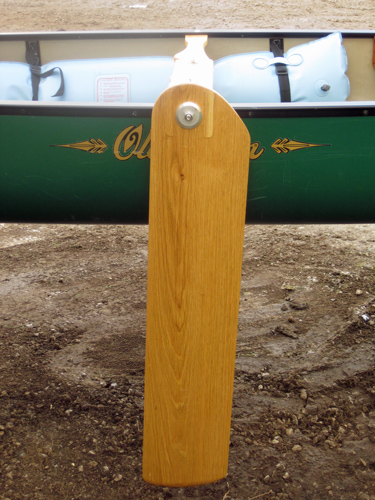
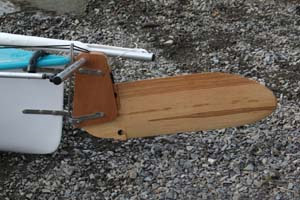 Solway Dory offer the same rudder as we fit on our canoes for you to fit on yours. The blade is made from hardwood and is carefully shaped into a good hydrofoil shape. It has an uphaul line to allow you to raise it before you land, or if you want to paddle. The rudder is held down with another line that has a shockcord in it. This allows the rudder blade to kick up if you run into an underwater obstacle. The rudder stock has a side mounted tiller arm onto which you can attach a long push pull tiller. We can supply several different ways of attaching the rudder to your canoe. Because canoes have different shaped ends we need to know which make and model it is. It is best to talk to us when you are ordering so that we can be sure to give you the most suitable fitting.
Read an article on how to fit this rudder to a plastic canoe .
This method is recommended for plastic canoes with a large radius stern
If you have a composite made canoe with a fine stern we would recommend the stainless strap rudder fittings that bolt on the outside of the canoe. This is how we fit to our own fibreglass sailing canoes. These fittings often work well on cedar strip & plywood canoes with narrow sterns.
Long Tiller Extension and Fitting = £50
Extendable alloy tubing tiller extension with rubber grip and fitting for the Solway Dory rudder. It allows you to operate the rudder from the middle of the canoe. It is adjustable from around 4ft to 8ft long.
Pivoting Leeboard = £150
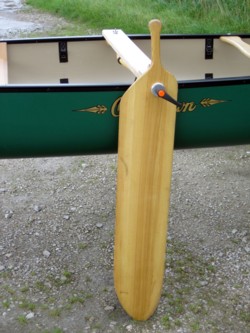 This is the board that we recommend for a full spec sailing rig. It is approx 4ft 5inches long and 8ins wide made from hardwood. It is carefully profiled to give a highly efficient hydrofoil that will allow the canoe to sail close to the wind, when combined with an efficient upwind sail. We fit this board to all our own sailing canoes. It is long enough to project well into the water when it is on the upwind side, so that you don't need to change sides with the board. The board will kick up with contact if you run into anything and it can be angled back when running or if sailing in shallow water.
This is our most efficient board and will make sailing to windward easy. Combined with a rudder the canoe will be easy to control and the canoe will "feel" more stable as the long board sitting deep in the water will dampen any quick movements of the canoe in waves.
We make them with a hardwood pad to fit on the starboard (right) side of the canoe as standard. If you would prefer to have it mounted on the port (left) side please tell us and we can make it that way.
Leeboard Bracket and Thwart = £85. Bracket only = £52.

 This is designed to mount a pivoting leeboard onto an open canoe. For most people we would suggest that it is bolted to the centre carrying yoke or to the gunwales, around 2ft behind the mast, allowing the sailing rig to be fitted just behind the front seat. The ash thwart comes complete with a heavy duty aluminium angle bolted on one end. This angle supports the leeboard bolt, washer (we now supply with a stainless steel washer, not the ally washer pictured) and locking handle. We can supply all the individual parts if you are making some of the parts yourself (p.o.a).
Expedition Leeboard = £135 Expedition Leeboard Thwart = £80


 We are now offering a Leeboard that is designed to work with the Expedition Rigs. For the paddler who wants to sail without a rudder and control the canoe with a paddle, the handle on our standard pivoting leeboard can get in the way and interfere with paddling strokes.
The Expedition Leeboard has a smoothly rounded top without a handle. The board can be set vertical for sailing upwind, and pulled back to move the centre of effort backwards for sailing off the wind or downwind. This can be done by moving the board with a single hand.
The board is made from top quality solid Ash and is carefully profiled into a low drag hydrofoil shape. By leaving off the handle found on the standard pivoting board we have kept down the length and price. We now include an eliptical tip found on the longer pivoting leeboard. The eliptical tip helps to reduce drag, especially when the board is angled backwards.
The board fits on a short leeboard thwart and bracket (sold separately) that can be bolted with wing nuts to the centre carrying yoke.
The board is held with a stainless steel washer and locking handle that can be adjusted (we no longer use the nut and large ally washer pictured). Once set it will hold the board to the angle that you set it, but will kick up if you run into an underwater object.
The short thwart is quick and easy to take off the yoke and the board and thwart will stow easily in the canoe without having to separate them. If you do not have a centre carrying yoke we can supply a longer leeboard thwart that will bolt in its place.
Side Buoyancy Bags: standard = £99.00 per pair; small = £77.00 per pair
 Most paddlers fit end buoyancy into their canoes. These make it easy for one canoeist to rescue another. However if you plan to go out sailing on your own, then it is sensible to have a strategy for self rescue. If you are sailing then there is an increased risk of capsize, and as people tend to sail on large bodies of water you may be some distance from the shore. Although end bags will allow you to right a canoe it will come up full of water. If you try to get back into the canoe it will get completely swamped and will be impossible to bail. It also becomes very unstable as the water flows from one side to the other. Side buoyancy bags, secured tightly under the gunwale at the centre of the canoe, will float the canoe high out of the water when it is on its side as you right it. This will result in only a few inches of water in the canoe after it is righted. It is possible to climb back into the canoe over the side without upsetting it. Usually a bit more water will get in in the process but the canoe will still have enough freeboard to bail it. Also the bags prevent all the water flowing to the side and making it unstable. One bag is better than none as you can get back in over that side but two bags make it more stable.
The most secure way to install side bags is with webbing straps bolted to the hull. The buoyancy bags include 2 straps per bag; with buckles on each strap. We can supply suitable nuts, bolts, & washers for the ends of the straps and we stock a range of other fittings - contact us for more info.
Please note that the bags we supply are now red or black in colour, they are purpose made for us.
We can also supply end air bags for open canoes. Please contact us for prices, typically £90 per pair.
See a demonstration of buoyancy bags in an open canoe on our video page
Standard side bags: 47" x 10" (120 x 25cm) with a buoyancy of approx 112lbs (50kg) 50 litres
Small side bags: 40" x 8" (100 x 20cm) with a buoyancy of approx 70lbs (30kg) 30 litres
Boat Covers -£330

 We make boat covers to fit over your solway dory sailing canoe. With a cover the canoe can be stored the right way up on its trolley. The mast fits along the centre line and supports the cover so that it sheds water.
The cover is made from high quality polyester and is kept taut by a cleated line that passes around the hull under the deck edge. Tie downs pass under the hull for extra security.